Insurance Runs on Paper — Even When the Paper Is a PDF
Every insurance policy, endorsement, premium receipt, and claim file has to be read by someone, identified, transcribed into two or three internal systems, and filed somewhere it can be found again eighteen months later. When the document is a phone photo of a national ID card, written in a mix of French and Arabic, that work is slow, inconsistent, and expensive.
I spent sixteen weeks building a system that does it automatically. This is the full engineering write-up: the architecture, the measured numbers, the decisions I would defend, and the ones I would revisit.
| Metric | Result | What it replaces |
|---|---|---|
| OCR accuracy (weighted) | 91.3% | 85.9% Tesseract alone / 85.1% EasyOCR alone |
| Classification F1 | 93.0% across 9 categories | Manual visual sorting |
| Entity extraction F1 | 90.4% across 10 entity types | Manual data entry |
| Search precision@1 | 92.1% | Exact-keyword lookup |
| Pipeline latency (median) | 6.8 s/document | 15-20 minutes manual |
| Search latency (median) | 0.3 s | Up to 48 h to find an archived contract |
| Usability (SUS) | 78.5 / 100 | — |
| Deployment | 100% on-premise | SaaS quoted above 100K MAD/month |
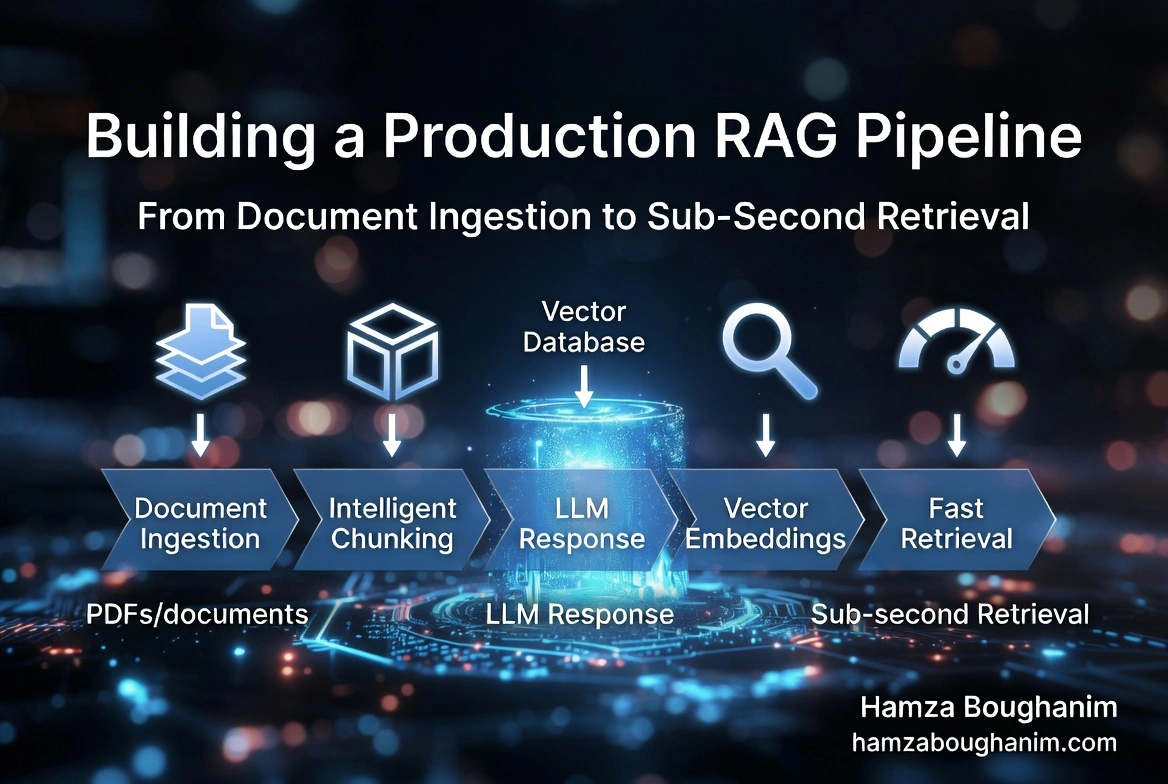
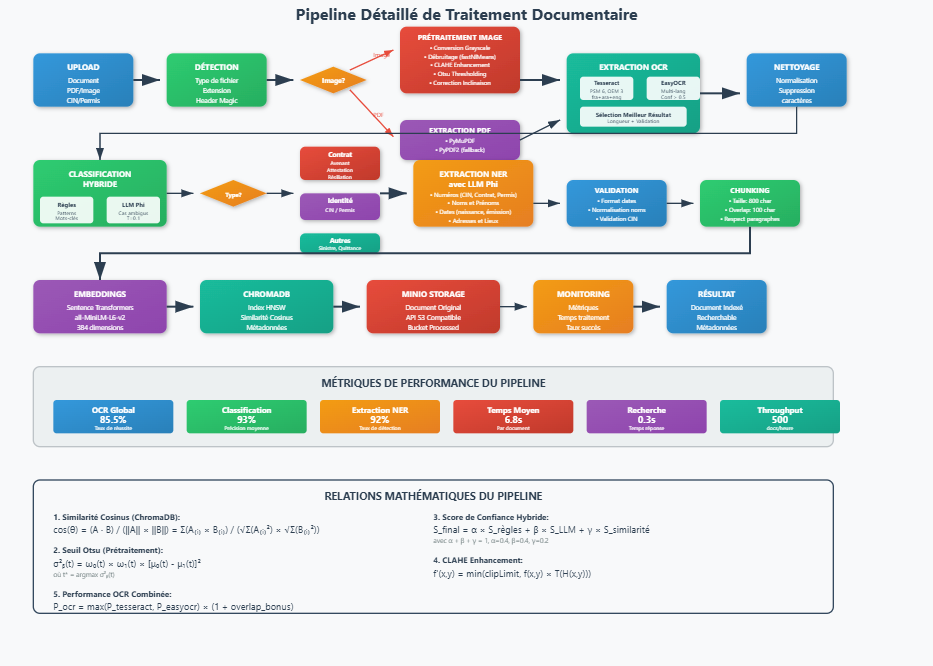
The stack in one line: Tesseract + EasyOCR → Phi-3 via Ollama → Sentence Transformers → ChromaDB → MinIO, behind a Flask API.
The Problem: Where Document Handling Breaks at Scale
Morocco's insurance sector is growing — 18.2 billion dirhams in revenue as of 31 March 2025, up 5.5% year-on-year according to ACAPS, the national regulator. More premiums means more paperwork, and the paperwork was already the bottleneck. Interviews with three major insurers produced a consistent picture:
- ~5,000 documents per day arriving at a single company
- 15-20 minutes of agent time per document, end to end
- 68% of agent hours consumed by manual data entry
- 12% error rate on manual keying
- 30% of claims delayed downstream as a consequence
- Up to 48 hours to locate a historical contract in the archive
Throughput ceiling. An experienced agent processes 15-25 documents per hour. That is a hard wall during fiscal year-end or a commercial campaign.
Quality variance. One agent types 15/03/2024, another types
15 mars 2024. The database now holds two formats for one concept, which poisons
every downstream automated process and every statistical report.
Retrieval failure. Search is limited to exact fields. When a customer calls and says "my car policy, the one I took out last year after I moved to Rabat", the agent runs four queries across three systems and cross-references by hand.
Why Off-the-Shelf Tools Did Not Fit
Three constraints eliminated the obvious commercial options.
- Language. Documents mix French and Arabic, occasionally with Darija annotations. Standard tooling measured below 65% accuracy on Moroccan national ID cards (CIN).
- Sovereignty. Sending scans of identity documents to a third-party cloud API is a compliance conversation nobody wanted. Local processing was the entry ticket, not a preference.
- Cost. SaaS document-AI platforms were quoted above 100,000 MAD per month. For a mid-size insurer the automation savings evaporate into the licence fee.
System Architecture: Six Modules, One Pipeline
Upload → Type detection → Preprocessing → Dual OCR → Fusion
   → Hybrid classification → NER extraction → Validation
→ Chunking → Embeddings → ChromaDB indexing → MinIO archival| Component | Technology | Rationale |
|---|---|---|
| Backend | Python + Flask | Lightweight, native to the ML ecosystem |
| OCR engine 1 | Tesseract 5.3 | Fast, excellent on structured French PDFs |
| OCR engine 2 | EasyOCR 1.7 | CNN-based, strong Arabic, robust on poor scans |
| Language model | Phi-3 (3.8B) via Ollama | Best accuracy-per-parameter; runs on consumer GPU |
| Embeddings | all-MiniLM-L6-v2 | 384-dim, fast, industry standard |
| Vector store | ChromaDB | HNSW indexing, native Python, no licence cost |
| Object storage | MinIO | S3-compatible, self-hosted, AES-256 at rest |
Communication uses HTTP/REST with JSON, direct Python calls inside the processing chain, and the S3 API for storage — deliberately boring protocols, because the interesting complexity belongs in the models, not the plumbing.
1. The Hybrid OCR Engine
This is the core contribution, and the insight is simple: the two engines fail in different places.
Tesseract 5.3 excels on clean structured layouts — contracts, certificates, anything with a predictable typographic grid. Fast (4.8 s/page), light on resources. It struggles with Arabic and handwriting, and degrades sharply as image quality drops.
EasyOCR 1.7 is CNN-based and handles French and Arabic simultaneously. Markedly better on identity documents, far more robust on low-quality scans. Slower (7.2 s/page), hungrier for memory.
On Moroccan CIN cards the gap is stark: EasyOCR 89.2% vs Tesseract 78.5%. On structured contracts it inverts: Tesseract 94.1% vs EasyOCR 87.8%. So the system runs both in parallel and picks the winner per document.
Adaptive Preprocessing Comes First
The right preprocessing depends on what is actually wrong with the scan:
| Scan quality | Typical source | Baseline | Treatment |
|---|---|---|---|
| High (>300 DPI) | Recent scanner output | 95% | Light CLAHE contrast enhancement |
| Medium (150-300 DPI) | Photocopies | 85% | Denoising + Otsu binarisation |
| Low (<150 DPI) | Phone photos | 62% | Text-region detection + perspective correction |
Adaptive preprocessing alone reduced OCR errors by 23% before any fusion logic ran.
The Fusion Decision
Score = 0.4 × TextLength + 0.4 × Confidence + 0.2 × ContextualValidationThe reasoning behind the weights: quantity of extracted information and intrinsic reliability are the two dominant signals, so together they carry 80%. Contextual validation — does the text actually contain the business patterns you would expect in an insurance document? — acts as a 20% guardrail against a result that looks statistically fine but is semantically nonsense. In the real implementation scores are normalised before comparison so both engines are judged on the same scale.
Content analysis feeds this: the system measures the ratio of Arabic to Latin characters and biases accordingly. Heavy Arabic favours EasyOCR. Clean structured French favours Tesseract. Poor image quality favours EasyOCR's robustness.
Tesseract Configuration That Mattered
| Parameter | Value | Why |
|---|---|---|
| PSM (Page Segmentation Mode) | 6 | Uniform text block — matches insurance forms |
| OEM (OCR Engine Mode) | 1 | LSTM engine only |
| Languages | fra+ara+eng | Multilingual support |
| Processing DPI | 300 | Optimal accuracy/speed tradeoff |
preserve_interword_spaces | 1 | Preserves spacing needed for field parsing |
EasyOCR ran two specialised readers — Latin (en, fr) and Arabic
(ar, en) — with a confidence threshold of 0.5 tuned empirically and a
1920×1920 maximum image size.
OCR Results
| Document type | Tesseract | EasyOCR | Hybrid | Time (s) |
|---|---|---|---|---|
| Contracts (PDF) | 91.2% | 87.8% | 94.1% | 4.2 |
| Endorsements | 86.7% | 84.2% | 90.5% | 6.1 |
| Certificates | 89.3% | 83.1% | 91.7% | 5.3 |
| Claims | 84.2% | 81.9% | 89.1% | 7.2 |
| Premium receipts | 88.9% | 85.4% | 92.8% | 4.8 |
| Cancellations | 87.1% | 83.7% | 90.9% | 5.9 |
| Supporting docs | 85.4% | 82.3% | 89.7% | 6.4 |
| Scanned CIN | 78.5% | 89.2% | 92.3% | 8.1 |
| Scanned licences | 82.1% | 85.7% | 88.9% | 7.9 |
| Weighted average | 85.9% | 85.1% | 91.3% | 6.2 |
The most interesting result is not in that table. It is this one:
| Source quality | Tesseract | EasyOCR | Hybrid | Gain |
|---|---|---|---|---|
| Excellent | 94.1% | 92.8% | 96.7% | +2.6% |
| Good | 89.2% | 87.5% | 93.1% | +3.9% |
| Medium | 81.7% | 83.2% | 88.9% | +7.2% |
| Poor | 72.3% | 76.1% | 81.8% | +9.5% |
The fusion helps most exactly where it is needed most. On pristine scans either engine works and the hybrid adds 2.6 points. On the degraded phone photos that make up a real share of insurance intake, it adds 9.5. That asymmetry is the argument for the entire approach.
2. Hybrid Classification: Rules First, Model Second
Stage 1 — Business Rules
| Document type | Typical keywords | Distinctive pattern |
|---|---|---|
| Insurance contract | souscripteur, prime, garanties | "police d'assurance n°" |
| National ID card | nationalité, né le, domicilié | "carte nationale d'identité" |
| Driving licence | catégories, délivré le | "permis de conduire" |
| Certificate | valide jusqu'au, certificat | "période de validité" |
Rules resolve roughly 80% of documents instantly, with no model inference at all.
Stage 2 — LLM Adjudication
When rule confidence falls below 0.8, Phi-3 is called with a constrained prompt:
Analyse this Moroccan insurance document text and classify it as one of:
Contract, Endorsement, Certificate, Claim, Receipt, Cancellation, CIN, Licence.

Text: [document extract]

Respond with the document type only.- Speed — 80% of traffic never touches the model
- Precision — the LLM handles genuinely ambiguous cases instead of every case
- Control — a business analyst can adjust a rule without retraining anything
- Auditability — for rule-classified documents you can point at the exact matched pattern, which matters in a regulated industry
Classification Results
| Type | Precision | Recall | F1 | Support |
|---|---|---|---|---|
| Contract | 94.0% | 92.1% | 93.0% | 85 |
| Endorsement | 89.0% | 88.2% | 88.6% | 76 |
| Certificate | 96.0% | 95.8% | 95.9% | 95 |
| Claim | 88.0% | 86.9% | 87.4% | 78 |
| Receipt | 93.0% | 92.1% | 92.5% | 89 |
| Cancellation | 91.0% | 89.6% | 90.3% | 67 |
| Supporting doc | 98.0% | 96.7% | 97.3% | 60 |
| CIN | 97.0% | 96.2% | 96.6% | 105 |
| Driving licence | 98.0% | 97.1% | 97.5% | 105 |
| Weighted average | 93.2% | 92.8% | 93.0% | 760 |
The errors concentrate exactly where you would expect: endorsements and claims, which share vocabulary with contracts and with each other. An endorsement is a modification to a contract, so it legitimately contains most of a contract's language. Identity documents, with rigid standardised layouts, hit 96-98%.
3. Named Entity Extraction with a Local LLM
Why Phi-3 and Not Something Bigger
| Model | Size | NER precision | Latency |
|---|---|---|---|
| BERT-base | 110M | 86% | 320 ms |
| Llama-2-7B | 7B | 89% | 2,100 ms |
| Phi-3 | 3.8B | 92% | 950 ms |
BERT is fast but not accurate enough for production. Llama-2-7B is accurate but the latency is brutal at volume. Phi-3 delivered the highest NER precision in this benchmark at roughly half the parameters of Llama-2 and under half the latency.
The broader principle I would defend: in production systems, "good enough + deployable + fast" beats "optimal + expensive + slow." A model that runs on an RTX 3060 in the client's own server room is worth more than a marginally better model that requires cloud inference and a compliance review.
SYSTEM:   Expert in information extraction from insurance documents
CONTEXT:  Moroccan insurance document, French/Arabic
TASK:     Extract {specific_entities}
FORMAT:   JSON with fields {field_list}
EXAMPLES: {few_shot_examples}
INPUT:    {document_text}
Structured output plus few-shot examples plus a fixed schema — the combination that turns a chatty model into a parser.
Hyperparameters and Their Justification
| Parameter | Value | Effect |
|---|---|---|
| Temperature | 0.1 | Near-deterministic; same document produces the same output |
| Top-p | 0.9 | Enough flexibility for linguistic variation, still coherent |
| Max tokens | 500 | Forces concision; blocks rambling non-answers |
| Repeat penalty | 1.1 | Prevents duplicated entity listings |
| Context length | 4096 | Fits most complete insurance documents |
Temperature at 0.1 is the single most important setting. Extraction is not a creative task — reproducibility matters more than fluency, and an auditor will eventually ask why the same document produced two different answers.
NER Results by Entity Type
| Entity | Detection | Precision | Recall | F1 | Support |
|---|---|---|---|---|---|
| CIN number | 98.1% | 97.2% | 96.8% | 97.0% | 410 |
| Licence number | 95.4% | 93.1% | 94.7% | 93.9% | 205 |
| Contract number | 96.2% | 94.1% | 92.8% | 93.4% | 350 |
| Date of birth | 94.1% | 92.4% | 93.8% | 93.1% | 410 |
| Client surname | 89.1% | 92.3% | 87.5% | 89.8% | 760 |
| Dates (general) | 91.4% | 88.2% | 89.7% | 88.9% | 1,240 |
| Client first name | 87.8% | 91.7% | 85.2% | 88.3% | 760 |
| Premium amount | 87.3% | 90.1% | 84.9% | 87.4% | 420 |
| Address | 83.2% | 85.1% | 81.3% | 83.2% | 760 |
| Place of birth | 81.7% | 84.2% | 79.3% | 81.7% | 410 |
| Weighted average | 91.8% | 91.2% | 89.6% | 90.4% | 5,515 |
Structured identifiers extract almost perfectly — free-text fields do not. CIN numbers follow a rigid format the model can anchor on. Addresses are unbounded natural language with inconsistent abbreviations, arbitrary line breaks, and no canonical form.
| Error source | Share | Example |
|---|---|---|
| Segmentation | 34% | Addresses split across lines, compound surnames truncated |
| Formatting | 28% | Ambiguous dates (03/04 — March or April?), malformed numbers |
| Contextual ambiguity | 23% | Agent name confused with client name |
| Propagated OCR errors | 15% | Character-level misreads flowing downstream |
Note the last row: only 15% of extraction failures originate in OCR. The majority are genuine NLP problems — which tells me the next round of improvement belongs in preprocessing and context modelling, not in a better OCR engine.
4. Embeddings and Chunking
all-MiniLM-L6-v2 from Sentence Transformers:
- 384 dimensions — dense enough to be informative, small enough to be fast
- 512 token maximum per input
- Mean pooling across non-masked tokens
- L2 normalisation, which makes cosine similarity a clean distance metric
Chunking Strategy
| Parameter | Value | Reasoning |
|---|---|---|
| Chunk size | 800 characters | Roughly 100-150 tokens, comfortably under the limit |
| Overlap | 100 characters (12.5%) | Prevents information loss at cut points |
| Cut points | Sentence boundaries | Syntactic segmentation preserves coherence |
| Metadata retained | Position, length, chunk ID | Enables traceability back to source |
overlap_optimal = min(100, 0.15 × chunk_size)Proportional to chunk size with a hard ceiling, so the ratio holds for small chunks without wasting compute on large ones.
Keeping per-chunk metadata mattered more than expected. When a search result surfaces a chunk, being able to say "this came from page 2, characters 1,600-2,400 of contract X" is the difference between a result a user trusts and one they have to verify manually.
5. Semantic Search with ChromaDB
The Problem with Keyword Search
| Query | Keyword search finds | Semantic search finds |
|---|---|---|
| contrat voiture | only "voiture" | auto, véhicule, automobile |
| accident route | those exact words | sinistre, collision, dommage |
| assurance maison | only "maison" | habitation, logement, domicile |
| mohamed alami | exact spelling only | Mohammed Allami, M. Alami |
That last row is the one agents care about most. Moroccan names transliterate inconsistently — Mohamed, Mohammed, Muhammad — and an exact-match system treats them as three different people.
"Contrat d'assurance automobile pour véhicule Renault"
  → [0.23, -0.45, 0.67, 0.12, ..., 0.89]

"Police auto pour voiture Peugeot"
  → [0.21, -0.43, 0.69, 0.14, ..., 0.87]   ← nearly identical

similarity = (A · B) / (|A| × |B|)          ← cosine, approaching 1 = same meaning
Why HNSW Matters
ChromaDB uses HNSW (Hierarchical Navigable Small World) indexing. Instead of comparing a query against every stored vector — O(N) — HNSW builds a navigable graph where similar documents are linked, and search walks toward the answer in O(log N). At 760 documents the difference is academic. At 500,000 it is the difference between a working product and a timeout.
| Technology | Precision@5 | Latency | Memory |
|---|---|---|---|
| FAISS | 87% | 120 ms | 1.2 GB |
| Pinecone | 89% | 200 ms | Cloud-hosted |
| ChromaDB | 89.3% | 110 ms | 0.9 GB |
| Metric | @1 | @5 | @10 | @20 |
|---|---|---|---|---|
| Precision | 92.1% | 89.3% | 85.7% | 79.2% |
| Recall | 31.4% | 74.8% | 91.6% | 96.3% |
| F1 | 46.8% | 81.6% | 88.5% | 86.9% |
| NDCG | 92.1% | 87.4% | 84.2% | 82.1% |
MRR: 0.847 · MAP: 0.823
Read this as two different user needs. "Find me this specific contract" is a precision@1 task — 92.1% means the right document is at the top nine times out of ten. "Show me everything related to this claim" is a recall@20 task — 96.3% means almost nothing is missed.
6. Security, Storage, and GDPR by Design
Handling national ID cards means compliance is not a checkbox at the end.
- Encryption at rest: AES-256 on every stored document in MinIO
- Encryption in transit: TLS 1.3 on all client-server communication
- Log anonymisation: CIN numbers masked before writing — a national ID appears as
XXXXXXXXin every log line, preserving traceability without preserving the identifier - Retention: Moroccan law requires 30-year retention for insurance contracts; the system manages the lifecycle explicitly and performs secure deletion once the statutory period expires
- Access and audit: role-based permissions, mandatory authentication, and a complete audit trail — every action timestamped with user identity and operation
- Sovereignty: no data leaves the building; Phi-3 runs locally through Ollama with no internet connection required and no third-party API in the processing path
Algorithmic Bias
A model trained on documents from one region performs worse on documents from another. The corpus was built with explicit geographic balance — Casablanca-Settat 32.0%, Rabat-Salé-Kénitra 18.0%, Marrakech-Safi 11.9%, Fès-Meknès 10.1%, Tanger-Tétouan-Al Hoceïma 9.0%, other regions 19.0%. Rural documents specifically make up 22% of the corpus, deliberately, because rural scans are systematically lower quality and excluding them would produce a model that quietly fails outside cities.
7. The Dataset
760 documents across 9 categories. Important caveat, stated plainly: this corpus was synthetically generated following statistical distributions derived from real sector data, not scraped from live customer files. That was a privacy decision, and it is the honest framing — it means the benchmarks measure the system against realistic-but-constructed documents, and real-world production numbers should be expected to differ.
| Document type | Count | Share |
|---|---|---|
| National ID cards | 105 | 13.8% |
| Driving licences | 105 | 13.8% |
| Certificates | 95 | 12.5% |
| Premium receipts | 89 | 11.7% |
| Contracts | 85 | 11.2% |
| Claims | 78 | 10.3% |
| Endorsements | 76 | 10.0% |
| Cancellations | 67 | 8.8% |
| Supporting documents | 60 | 7.9% |
| Total | 760 | 100% |
Quality Distribution — Deliberately Harsh
| Quality level | Count | Mean DPI | SNR (dB) | OCR legibility |
|---|---|---|---|---|
| Excellent | 183 | 600 | >25 | >95% |
| Good | 196 | 300 | 20-25 | 85-95% |
| Medium | 171 | 150 | 15-20 | 70-85% |
| Poor | 210 | 75 | <15 | 50-70% |
210 documents — 27.6% of the corpus — are deliberately poor quality. Degradation was applied programmatically as a product of noise, blur, and skew factors. Benchmarking only on clean scans produces impressive numbers and a system that falls over in week one. The 91.3% headline figure includes those 210 bad documents.
8. Performance: Where the Time Actually Goes
| Operation | Min | P50 | P90 | P99 | Max |
|---|---|---|---|---|---|
| OCR + preprocessing | 1.2 | 4.8 | 12.1 | 28.3 | 45.7 |
| Hybrid classification | 0.1 | 0.3 | 0.8 | 2.1 | 5.2 |
| NER extraction | 0.2 | 0.7 | 1.9 | 4.8 | 12.1 |
| Embedding generation | 0.1 | 0.2 | 0.5 | 1.2 | 3.1 |
| ChromaDB indexing | 0.05 | 0.1 | 0.3 | 0.8 | 2.1 |
| MinIO storage | 0.2 | 0.8 | 2.1 | 5.2 | 11.3 |
| Semantic search | 0.1 | 0.3 | 0.7 | 1.8 | 4.2 |
| Full pipeline | 2.1 | 6.8 | 16.2 | 38.1 | 72.4 |
All values in seconds.
OCR consumes roughly 70% of total processing time. Every other stage is effectively free by comparison. That is the optimisation target, and it is why intelligent OCR caching sits at the top of the roadmap. The P99 of 38 seconds is worth noticing too — those are the multi-page, badly-scanned edge cases. Averages hide them; percentiles do not.
Hardware: NVIDIA RTX 3060 (12GB) minimum, 16GB RAM for 50 concurrent documents, 2TB storage for a 500,000-document archive. Consumer-grade, deliberately.
9. Interface and Usability Testing
The best extraction pipeline in the world is worthless if agents will not use it.
Frontend: HTML5/CSS3, JavaScript ES6+, Bootstrap 5, Chart.js. Responsive, WCAG 2.1 Level AA compliant, sub-2-second page loads. Multi-file drag and drop up to 50 documents, real-time preview, per-stage progress bars, advanced filtering, semantic search with relevance scores, highlighted extracted metadata, confidence indicators, CSV/Excel export, and a metrics dashboard.
Test protocol: 7 participants (5 agents, 2 managers), 45-minute sessions, 8 representative workflow tasks, think-aloud protocol with screen recording and post-test questionnaires.
| Task | Mean time | Success rate | Satisfaction |
|---|---|---|---|
| Upload documents | 45s | 100% | 4.6/5 |
| Simple search | 32s | 95% | 4.4/5 |
| Advanced search | 78s | 85% | 4.1/5 |
| Validate extraction | 56s | 90% | 4.3/5 |
| Navigate results | 28s | 100% | 4.7/5 |
| Export data | 41s | 95% | 4.2/5 |
| System configuration | 124s | 75% | 3.8/5 |
| Error handling | 89s | 80% | 3.9/5 |
| Overall | 62s | 90% | 4.25/5 |
SUS score: 78.5/100 — solidly in "good usability" territory on the standard scale.
The two weak rows tell the real story. System configuration and error handling — 75% and 80% success, 3.8/5 and 3.9/5 — are where the interface failed people. Both are admin-facing surfaces that got less design attention than the core agent workflow — a classic and entirely predictable outcome, and one worth naming rather than burying under the 4.25 average.
10. Business Impact
| Dimension | Before | After | Change |
|---|---|---|---|
| Processing time | 20 min/doc | 2 min/doc | 10× faster |
| Error rate | 12% | <1% | 12× reduction |
| Contract retrieval | 48 hours | 30 seconds | ~5,760× faster |
| Audit trail | Manual | Automatic | — |
| Annual savings | — | 675,000 MAD | — |
Projected ROI of 198% over three years, break-even at 12 months. These are projections built on measured per-document time savings extrapolated across volume, not realised financials from a production deployment. Treat them as a business case, not an audited result.
Comparison Against Commercial Alternatives
| Criterion | This system | Adobe DC | ABBYY | Google Cloud |
|---|---|---|---|---|
| Arabic/French OCR | Excellent | Moderate | Excellent | Excellent |
| Classification | Hybrid (rules + AI) | Basic | Advanced | Moderate |
| Semantic search | ChromaDB / HNSW | No | Proprietary | Vertex AI |
| On-premise deployment | Yes | No | Limited | No |
| 3-year total cost | 680K MAD | 1.5M MAD | 2.1M MAD | 1.8M MAD |
| Customisation | Total | Limited | Partial | No |
Fairness note: this comparison reflects the requirements of this use case, and the cost figures are quoted rather than independently audited. ABBYY in particular is a mature, deeply capable platform, and for an organisation without on-premise constraints or Arabic-language requirements the calculus would likely favour a commercial product with vendor support behind it. The advantage here comes from specialisation and sovereignty, not from being categorically better software.
11. Honest Limitations
Every system write-up should have this section, and most do not.
- Handwriting. Error rate on handwritten documents reaches 23%. Both OCR engines are optimised for print, and claim declarations are frequently handwritten. This is the largest open gap.
- Non-standard layouts. Multi-column documents, heavy tables, and unconventional forms degrade noticeably.
- Long documents. Documents over 20 pages average 42 seconds — acceptable for batch, uncomfortable for interactive use.
- Hybrid document types. Endorsements sit at a 7% classification error rate because they legitimately share most of their vocabulary with contracts. Distinguishing them requires understanding document intent, not just content.
- Cascade dependency. Everything downstream depends on OCR quality. A bad extraction produces a bad classification, bad entities, and a bad embedding.
- Synthetic evaluation data. The 760-document corpus is synthetic. It matches real distributions and includes deliberate quality degradation, but it is not a production dataset.
- Small usability sample. Seven test participants is enough to surface obvious friction, not enough to be statistically robust.
12. Roadmap
Short term.
- LLaVA integration for visual document analysis — reading logos, stamps, and signatures alongside text
- LoRA fine-tuning of Phi-3 on the nine insurance categories: rank 8, alpha 16, dropout 0.1,
targeting
q_projandv_proj, batch size 16, learning rate 3e-4. Expected 75% reduction in GPU memory while retaining ~95% of full fine-tuning performance. - Intelligent OCR caching to attack the 70% of pipeline time spent on extraction
Medium term — full multimodal architecture with late fusion:
P(y|X) = α · P_visual(y|X) + (1 - α) · P_textual(y|X)where α is learned from per-modality quality — expected 15-20% improvement on degraded documents. Plus handwriting support via visual transformers and ERP/CRM connectors.
Long term.
- Predictive risk analysis and fraud detection through anomaly detection
- Blockchain-backed immutable document traceability
- Regional expansion across the Maghreb with extended multilingual support
- Cross-sector application — banking, healthcare, public administration
What I Would Tell Someone Building This
- Hybridise where failure modes differ. Two OCR engines only beat one because Tesseract and EasyOCR fail on different inputs. Two models that fail identically give you cost, not accuracy. The same logic drove rules-plus-LLM classification: rules fail on ambiguity, LLMs fail on consistency, and combining them covers both.
- Rules are not legacy technology. 80% of documents classified correctly with zero inference. Reaching for a model when a regex works is expensive, slow, and harder to audit.
- Benchmark on the ugly data. 27.6% of the evaluation corpus is deliberately degraded. That is why the reported numbers are believable and why the system does not collapse on phone photos.
- Deployability is a feature. Choosing Phi-3 over Llama-2-7B prioritised something that runs on hardware the client already owns. Local execution was not just compliance — it made the project viable at all.
- Measure percentiles, not averages. The 6.8s median is the headline. The 38s P99 is the user complaint.
- Instrument the errors, not just the accuracy. Knowing that 34% of NER failures are segmentation problems and only 15% are OCR-propagated told me exactly where the next sprint should go. Aggregate accuracy would have told me nothing.
Final Thought
The interesting result here is not 91.3% OCR accuracy. It is where that 91.3% comes from: a hybrid architecture that gains 9.5 percentage points on bad scans and only 2.6 on good ones, rules that answer 80% of classification questions before a model wakes up, and a 3.8B-parameter model chosen specifically because it runs on hardware the client already owns.
Production AI systems are not won by picking the largest model. They are won by understanding exactly where each component fails, building something that covers the gaps, and then measuring honestly enough to know which gaps are still open.
This work was submitted as my Master's thesis in Artificial Intelligence and Virtual Reality at Université Ibn Tofail, Faculty of Sciences, Kénitra, in partnership with Assure Solutions Morocco.
Built with: Python · Flask · Tesseract · EasyOCR · Ollama · Phi-3 · Sentence Transformers · ChromaDB · MinIO · OpenCV · Docker
References
- Phi-3 Technical Report: A Highly Capable Language Model Locally On Your Phone — Microsoft Research
- Sentence-BERT: Sentence Embeddings using Siamese BERT-Networks — Reimers & Gurevych
- Efficient and Robust Approximate Nearest Neighbor Search Using HNSW Graphs — Malkov & Yashunin
- ChromaDB — the AI-native open-source embedding database
- Tesseract OCR documentation
- EasyOCR — ready-to-use OCR with 80+ supported languages
- ACAPS — Moroccan insurance and social welfare supervisory authority