Introduction
What Are LLM Frameworks?
An LLM framework is the scaffolding that sits between "call a model API" and "build a working product." A raw call to a chat completions endpoint gives you text in, text out. Everything else — retrieving relevant documents, calling tools, keeping track of conversation state, running a multi-step plan, retrying a failed step — is left to you. Frameworks exist to standardize that scaffolding so you're not reinventing prompt templates, retrieval pipelines, and agent loops on every project.
Why Do We Need Frameworks for Generative AI?
You don't, strictly — plenty of production systems call the model API directly with a thin layer of custom code, and that's often the right call for a narrow, well-understood task. Frameworks earn their place once the problem grows in one of a few directions: the app needs to ground answers in your own documents (retrieval-augmented generation), the app needs the model to take multiple steps and call tools autonomously (agents), or the app needs to coordinate several of those steps with branching, retries, and state that persists across turns (orchestration). Each of the four frameworks below leans into a different corner of that space.
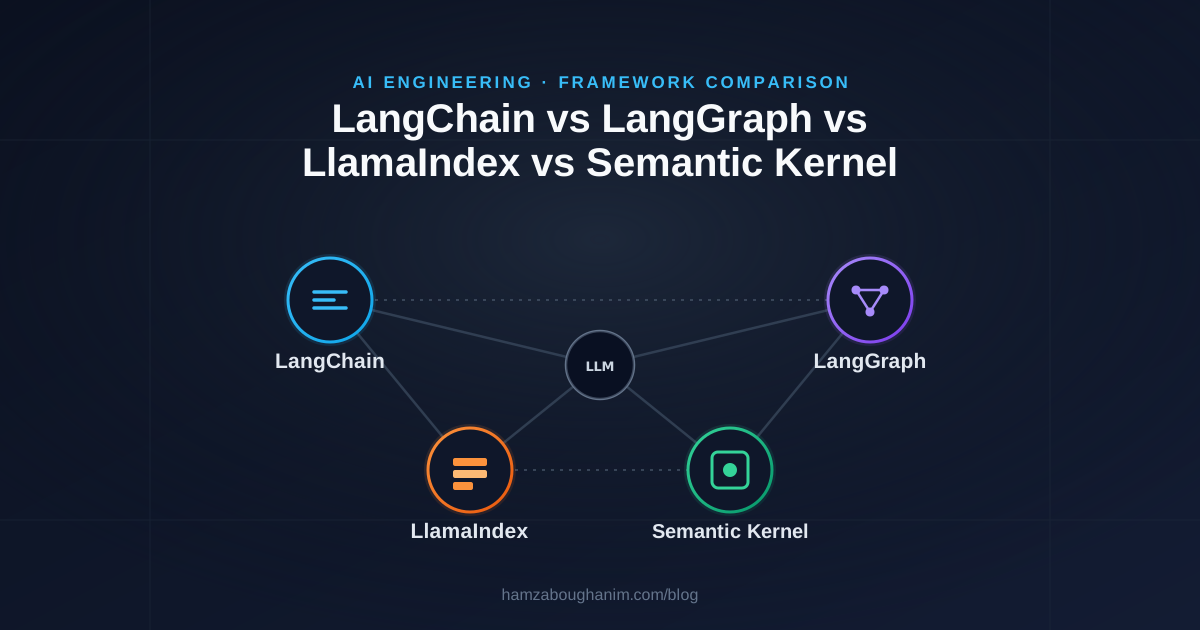
LangChain vs LangGraph vs LlamaIndex vs Semantic Kernel at a Glance
| Framework | Primary strength | Mental model |
|---|---|---|
| LangChain | General-purpose LLM app building blocks | Composable chains of prompts, models, and tools |
| LangGraph | Stateful, controllable agent workflows | A graph of nodes and edges with explicit state |
| LlamaIndex | Data ingestion and retrieval for RAG | Your documents, indexed and queryable |
| Semantic Kernel | Enterprise-grade, multi-language AI orchestration | Plugins and planners inside your existing app |
None of these are mutually exclusive. The most common production pattern, in fact, uses more than one at once — LlamaIndex handling retrieval, LangGraph handling the agent loop that calls it. More on that combination later.
What Is LangChain?
What Is LangChain?
LangChain is a general-purpose framework for building applications powered by language models. It provides standardized interfaces for prompts, models, output parsing, memory, retrieval, and tool calling, so swapping an OpenAI model for an Anthropic one — or adding a vector store — doesn't mean rewriting your application logic.
Key Features of LangChain
- Model-agnostic interfaces — the same chain code runs against different LLM providers
- Prompt templates — reusable, parameterized prompts instead of string concatenation
- Chains — composable sequences of calls (prompt → model → parser → next step)
- Tool calling — a standard way to expose functions the model can invoke
- Memory and retrieval integrations — connectors for dozens of vector stores and document loaders
How LangChain Works
The core abstraction is the Runnable — anything that takes an input and
produces an output, and can be piped into the next Runnable with the |
operator (LangChain Expression Language, or LCEL). A chain is just a pipeline of these.
from langchain_anthropic import ChatAnthropic
from langchain_core.prompts import ChatPromptTemplate
from langchain_core.output_parsers import StrOutputParser

model = ChatAnthropic(model="claude-sonnet-4-6")
prompt = ChatPromptTemplate.from_template(
    "Summarize the following in one sentence:\n\n{text}"
)

chain = prompt | model | StrOutputParser()

result = chain.invoke({"text": "Long article text goes here..."})
print(result)
LangChain Architecture
Prompt Template
      ↓
   Chat Model
      ↓
 Output Parser
      ↓
  (optional) Tool Call → Tool Execution → back into the chain
LangChain for RAG
LangChain provides retrievers, text splitters, and vector-store integrations that plug directly into a chain: split documents, embed them, store them, retrieve the top-k matches for a query, and inject them into the prompt.
from langchain_community.vectorstores import Chroma
from langchain_core.runnables import RunnablePassthrough

retriever = Chroma(embedding_function=embeddings).as_retriever(search_kwargs={"k": 5})

rag_chain = (
    {"context": retriever, "question": RunnablePassthrough()}
    | prompt
    | model
    | StrOutputParser()
)

answer = rag_chain.invoke("What is the policy on data retention?")
LangChain for AI Agents
LangChain exposes prebuilt agent constructors that wrap the reasoning loop — decide, call a tool, observe, repeat — around a set of tools you provide.
from langchain.agents import create_tool_calling_agent, AgentExecutor

agent = create_tool_calling_agent(model, tools, prompt)
executor = AgentExecutor(agent=agent, tools=tools, max_iterations=10)

result = executor.invoke({"input": "What's the weather in Tangier, then convert it to Fahrenheit"})
When Should You Use LangChain?
When you need a general-purpose toolkit for a single, relatively linear LLM application — a RAG chatbot, a document summarizer, a simple single-agent tool-caller — and you want broad ecosystem support (model providers, vector stores, loaders) without writing that glue code yourself.
Advantages and Limitations of LangChain
| Advantages | Limitations |
|---|---|
| Huge ecosystem of integrations | Abstraction layers can obscure what's actually happening |
| Fast to prototype with | Complex, branching agent logic gets awkward to express |
| Large community, lots of examples | API has changed significantly across versions |
| Works with nearly every model provider | Less control over execution flow than a graph-based approach |
What Is LangGraph?
What Is LangGraph?
LangGraph is a library, built by the LangChain team, for constructing stateful, multi-step LLM applications as an explicit graph: nodes are units of work, edges define how control flows between them, and a shared state object is passed and updated at every step. It exists specifically because LangChain's chain-based composition gets unwieldy once an agent's control flow needs branching, loops, or persistence.
LangGraph vs LangChain
| Aspect | LangChain | LangGraph |
|---|---|---|
| Control flow | Mostly linear chains, some branching | Explicit graph — any node can route to any other |
| State | Implicit, passed through the chain | Explicit, typed state object updated at each node |
| Loops / cycles | Awkward — agents wrap this for you | Native — a graph can cycle back to earlier nodes |
| Persistence | Manual | Built-in checkpointing, so a run can pause and resume |
| Best for | Simple to moderately complex apps | Complex, long-running, or multi-agent workflows |
Understanding Nodes, Edges and State
from langgraph.graph import StateGraph, END
from typing import TypedDict

class AgentState(TypedDict):
    question: str
    context: str
    answer: str

def retrieve(state: AgentState) -> AgentState:
    state["context"] = retriever.invoke(state["question"])
    return state

def generate(state: AgentState) -> AgentState:
    state["answer"] = model.invoke(f"{state['context']}\n\n{state['question']}")
    return state

graph = StateGraph(AgentState)
graph.add_node("retrieve", retrieve)
graph.add_node("generate", generate)
graph.set_entry_point("retrieve")
graph.add_edge("retrieve", "generate")
graph.add_edge("generate", END)

app = graph.compile()
result = app.invoke({"question": "What is the refund policy?"})
Building Stateful AI Agents
Because state persists explicitly across nodes, a LangGraph agent can loop — retrieve, check if the answer is good enough, retrieve again with a refined query, generate — with the looping logic expressed as a conditional edge rather than bolted-on retry code.
def should_retry(state: AgentState) -> str:
    return "generate" if len(state["context"]) > 0 else "retrieve"

graph.add_conditional_edges("retrieve", should_retry, {
    "generate": "generate",
    "retrieve": "retrieve",
})
LangGraph for Multi-Agent Systems
Each agent can be its own subgraph or node, with a coordinator node routing between them based on the current state — the same orchestrator–worker pattern covered in The Agentic Loop, expressed as graph edges instead of nested function calls.
Human-in-the-Loop Workflows
LangGraph's checkpointing lets a graph pause at a node — say, before an irreversible action — persist its state, and wait for external approval before resuming. This is the same guardrail principle discussed in The Agent Harness, implemented natively at the framework level rather than as custom middleware.
When Should You Use LangGraph?
When your workflow has real branching logic, needs to loop until a condition is met,
involves multiple cooperating agents, or needs to pause for human approval and resume
later. If you find yourself writing a while loop with manual state tracking
around a LangChain agent, that's the signal to move to LangGraph.
Advantages and Limitations of LangGraph
| Advantages | Limitations |
|---|---|
| Explicit, debuggable control flow | More upfront design work than a simple chain |
| Native cycles and conditional routing | Steeper learning curve |
| Built-in persistence and human-in-the-loop | Overkill for a single-step task |
| Composes well with plain LangChain components | Still a young, fast-moving API |
What Is LlamaIndex?
What Is LlamaIndex?
LlamaIndex is a data framework purpose-built for connecting LLMs to your own data. Where LangChain treats retrieval as one integration among many, LlamaIndex treats it as the entire point: ingesting documents from dozens of sources, indexing them efficiently, and exposing high-quality retrieval and query interfaces on top.
LlamaIndex and RAG
RAG is LlamaIndex's home turf. It provides multiple index types (vector, list, tree, keyword), multiple retrieval strategies, and query engines that go beyond naive top-k similarity search — sub-question decomposition, routing between indexes, and response synthesis over multiple retrieved chunks.
Document Ingestion and Indexing
from llama_index.core import VectorStoreIndex, SimpleDirectoryReader

documents = SimpleDirectoryReader("./policy_docs").load_data()
index = VectorStoreIndex.from_documents(documents)

query_engine = index.as_query_engine(similarity_top_k=5)
response = query_engine.query("What is the maximum data retention period?")
print(response)
The chunking, embedding-model choice, and index type decisions here follow the same principles covered in Building a Production RAG Pipeline — LlamaIndex mainly changes how much of that plumbing you write by hand.
Vector Search and Retrieval
LlamaIndex integrates with the same vector databases used elsewhere in the ecosystem — pgvector, Chroma, Pinecone, Weaviate — and adds retrieval-quality features like auto-merging retrieval (combining child chunks back into their parent context) and hybrid search out of the box.
LlamaIndex for Knowledge Bases
Beyond single-shot Q&A, LlamaIndex's ChatEngine and multi-document agents
let you build a persistent, queryable knowledge base — useful for the kind of internal
documentation or policy-manual search that comes up constantly in enterprise deployments.
LlamaIndex vs LangChain
| Aspect | LlamaIndex | LangChain |
|---|---|---|
| Core focus | Data ingestion, indexing, retrieval | General-purpose LLM app building |
| RAG depth | Very deep — many index/retrieval strategies | Solid, but retrieval is one feature among many |
| Agents | Supported, less central | First-class, extensive tooling |
| Typical role | The retrieval layer inside a larger app | The application layer itself |
When Should You Use LlamaIndex?
When retrieval quality over your own documents is the core problem — a document Q&A system, an internal search tool, a knowledge-base assistant — and you want more retrieval sophistication than a basic top-k vector search out of the box.
Advantages and Limitations of LlamaIndex
| Advantages | Limitations |
|---|---|
| Best-in-class retrieval strategies | Less mature agent/orchestration tooling than LangChain or LangGraph |
| Wide range of data connectors (LlamaHub) | Smaller ecosystem outside of RAG use cases |
| Query engines beyond naive similarity search | Another framework to learn if you already know LangChain |
What Is Microsoft Semantic Kernel?
What Is Semantic Kernel?
Semantic Kernel (SK) is Microsoft's open-source SDK for integrating LLMs into existing applications, with first-class support across C#, Python, and Java. It's built around the idea of embedding AI capabilities into software you already have, rather than building a standalone AI-first application from scratch.
Semantic Kernel Architecture
Application Code
      ↓
    Kernel
      ↓
┌─────────┬──────────┬───────────┐
│ Plugins │ Planners │  Memory   │
└─────────┴──────────┴───────────┘
      ↓
  AI Service (Azure OpenAI, OpenAI, etc.)
Plugins and AI Functions
A plugin in SK groups related functions — native code or prompt-based — that the kernel can invoke, conceptually similar to LangChain tools but designed to sit alongside existing enterprise codebases.
var kernel = Kernel.CreateBuilder()
    .AddAzureOpenAIChatCompletion(deploymentName, endpoint, apiKey)
    .Build();

kernel.ImportPluginFromType();

var result = await kernel.InvokePromptAsync(
    "What time is it, and summarize it for a user in Morocco."
);
Console.WriteLine(result);
Semantic Kernel for AI Agents
SK's planner components let the kernel decompose a goal into a sequence of plugin calls automatically, similar in spirit to LangChain's agents but tuned for enterprise workflows that mix AI calls with existing business logic and internal APIs.
Semantic Kernel and Azure OpenAI
SK has the deepest first-party integration with Azure OpenAI of any framework here, including Azure-specific auth, content filtering, and telemetry — a natural fit if your organization is already standardized on Azure.
Semantic Kernel for Enterprise Applications
Because SK is designed to be embedded into existing .NET and Java applications rather than to be the application, it fits naturally into enterprises with established codebases, compliance requirements, and multi-language teams — where "rewrite this in Python" isn't a realistic option.
Semantic Kernel vs LangChain
| Aspect | Semantic Kernel | LangChain |
|---|---|---|
| Language support | C#, Python, Java (first-class) | Python, JavaScript/TypeScript |
| Target environment | Existing enterprise applications | Standalone AI applications |
| Ecosystem size | Smaller, Microsoft-centric | Larger, more community integrations |
| Cloud integration | Deepest with Azure | Broad, provider-agnostic |
When Should You Use Semantic Kernel?
When you're adding AI capabilities to an existing C#, Java, or enterprise Python application, especially one already on Azure, and you need first-party support across those languages rather than a Python-only tool.
LangChain vs LangGraph vs LlamaIndex vs Semantic Kernel
Feature Comparison
| Feature | LangChain | LangGraph | LlamaIndex | Semantic Kernel |
|---|---|---|---|---|
| LLM applications | Yes | Yes | Yes | Yes |
| RAG | Strong | Moderate | Strongest | Moderate |
| Simple agents | Strongest | Strong | Moderate | Strong |
| Stateful / cyclic agents | Moderate | Strongest | Weak | Moderate |
| Multi-agent systems | Moderate | Strongest | Moderate | Strong |
| Document processing | Strong | Moderate | Strongest | Moderate |
| Workflow control | Moderate | Strongest | Moderate | Strong |
| Enterprise / non-Python | Moderate | Moderate | Moderate | Strongest |
| Python support | Strongest | Strongest | Strongest | Strong |
Read this table as "where does each framework's design center of gravity sit," not as a strict ranking — LlamaIndex can build an agent, LangGraph can do RAG, but each is optimized for the row where it scores highest.
RAG: Which Framework Should You Choose?
LangChain for RAG
Good default when RAG is one piece of a broader app that also needs agents, memory, and tool calling under one roof.
LlamaIndex for RAG
Better default when retrieval quality itself is the product — more index types, better chunking strategies, and query engines built specifically for document-heavy use cases.
LangGraph for Advanced RAG Workflows
Reach for this when RAG needs to be agentic — deciding whether to retrieve again, routing between multiple retrievers, or validating an answer against sources before returning it, all as explicit graph logic.
Semantic Kernel for Enterprise RAG
The right fit when the RAG system needs to live inside an existing enterprise C#/Java application rather than as a new standalone Python service.
Simple RAG vs Agentic RAG
Simple RAG:    Query → Retrieve → Generate → Answer
Agentic RAG:   Query → Plan → Retrieve → Evaluate → (Retrieve again?) → Generate → Answer
AI Agents: Which Framework Is Best?
Simple Agent
    ↓
LangChain

Complex Stateful Agent
    ↓
LangGraph

Data-Centric Agent
    ↓
LlamaIndex

Enterprise Agent
    ↓
Semantic Kernel
As agent complexity grows — more tools, longer horizons, human approval steps — the case for LangGraph's explicit state and control flow gets stronger. The guardrail and sandbox concerns that apply once an agent executes real actions are covered in The Agent Harness and Sandboxing AI Agents, and apply regardless of which of these four frameworks sits on top.
Real-World Architecture Examples
RAG Chatbot Architecture
User
 ↓
Retriever
 ↓
Vector Database
 ↓
LLM
 ↓
Answer
Agentic RAG Architecture
User
 ↓
Planner
 ↓
Retriever
 ↓
Tools
 ↓
Validator
 ↓
LLM
 ↓
Answer
Multi-Agent Architecture
             User
               ↓
            Planner
          ↙    ↓    ↘
     Research  Data  Analysis
          ↘    ↓    ↙
           Validator
               ↓
             Answer
Code Examples
Simple LangChain Example
chain = prompt | model | StrOutputParser()
chain.invoke({"text": "..."})
LangGraph Agent Example
graph = StateGraph(AgentState)
graph.add_node("retrieve", retrieve)
graph.add_node("generate", generate)
graph.set_entry_point("retrieve")
graph.add_edge("retrieve", "generate")
app = graph.compile()
LlamaIndex RAG Example
index = VectorStoreIndex.from_documents(documents)
query_engine = index.as_query_engine()
query_engine.query("...")
Semantic Kernel Example
var kernel = Kernel.CreateBuilder()
    .AddAzureOpenAIChatCompletion(deploymentName, endpoint, apiKey)
    .Build();
await kernel.InvokePromptAsync("...");
Which Framework Should You Choose?
Choose LangChain If...
You're building a general-purpose LLM app in Python or JS, want the widest range of integrations, and your control flow is mostly linear.
Choose LangGraph If...
Your agent needs to loop, branch, coordinate multiple sub-agents, or pause for human approval and resume later.
Choose LlamaIndex If...
Retrieval over your own documents is the core problem, and you want deeper indexing and query strategies than a basic vector search.
Choose Semantic Kernel If...
You're embedding AI into an existing C#, Java, or enterprise application, especially one already standardized on Azure.
Can You Use Multiple Frameworks Together?
Yes — and in practice, this is extremely common. A typical production pattern uses LlamaIndex for ingestion and retrieval, wrapped as a tool inside a LangGraph agent that handles the orchestration and multi-step reasoning:
                Application
                     ↓
                LangGraph
                     ↓
        ┌────────────┴────────────┐
        ↓                         ↓
   LangChain                 LlamaIndex
     Tools                       RAG
        ↓                         ↓
        └────────────┬────────────┘
                     ↓
                    LLM
My Recommendations
- Best for RAG: LlamaIndex, for retrieval depth; LangChain if RAG is one part of a larger app.
- Best for AI agents: LangChain for simple tool-calling agents.
- Best for multi-agent systems: LangGraph.
- Best for document AI: LlamaIndex.
- Best for enterprise AI: Semantic Kernel.
- Best for .NET applications: Semantic Kernel.
- Best for Python developers: LangChain and LangGraph together cover the widest range of Python use cases.
The Future of LLM Frameworks
From Chains to Agents
The industry-wide shift is from static, predefined chains toward agents that decide their own steps — which is exactly why LangGraph exists as a separate library from LangChain rather than a feature within it.
Agentic RAG
Retrieval is increasingly treated as a tool an agent chooses to call, possibly multiple times with refined queries, rather than a fixed first step in a pipeline.
Multi-Agent Systems
Orchestrator–worker patterns, covered in depth in The Agentic Loop, are becoming a first-class citizen in these frameworks rather than something built by hand on top of them.
Model Context Protocol (MCP)
An emerging standard for exposing tools and data sources to any LLM application in a consistent way, reducing the need for framework-specific tool integrations.
Long-Term Memory
Frameworks are converging on layered memory — working, episodic, and semantic — rather than treating "memory" as a single conversation buffer.
AI Workflow Orchestration
The line between "agent framework" and "workflow orchestration engine" continues to blur, as production systems demand the durability and observability guarantees traditionally associated with workflow engines.
Conclusion
LangChain vs LangGraph vs LlamaIndex vs Semantic Kernel: Final Verdict
Need RAG?              → LlamaIndex / LangChain
Need AI Agent?          → LangChain
Need complex Agent?     → LangGraph
Need Multi-Agent?       → LangGraph
Need Document AI?       → LlamaIndex
Need Microsoft/.NET?    → Semantic Kernel
Need Enterprise AI?     → Semantic Kernel
None of these frameworks are competitors in the strict sense — they overlap at the edges but are each optimized for a different center of gravity: LangChain for general-purpose app building, LangGraph for controllable agent workflows, LlamaIndex for retrieval depth, and Semantic Kernel for embedding AI into existing enterprise software. The right choice is rarely "pick one forever" — it's understanding which problem you actually have this time, and reaching for the tool built around that problem.
Further Reading
- Building a Production RAG Pipeline — the retrieval fundamentals underneath both LangChain and LlamaIndex